Lighthouse Initiatives and projects
The flagship efforts of the AI Core Plan, and the CERN projects connected to them.
Artificial Intelligence / Lighthouse Initiatives and projects
What are the AI Lighthouse Initiatives?
The Lighthouse Initiatives are the flagship efforts of the AI Core Plan. Each is cross-cutting, draws on several of the Plan’s objectives, and grows out of work already under way across CERN and the experiments. Together they show what AI can make possible for physics, accelerators and operations. Select “More details” on a card to see what it delivers and when.
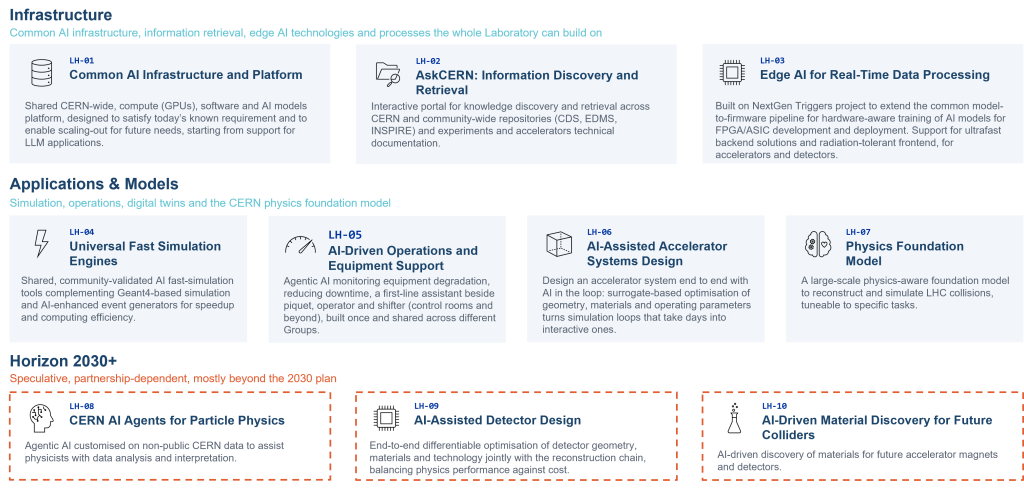
Seven initiatives can be delivered within the Plan’s technology, timeline and funding.
Cross-cutting
LH1 – Common AI Infrastructure and Platform
One shared foundation for AI at CERN, so that scientific and operational teams build on common computing, storage and tools.
More details
What it delivers: A CERN-wide AI compute, storage and MLOps platform with a central model registry and support for the full model lifecycle, including agentic AI. It serves scientific and operational AI across all sectors.
Pillar: all
Timeline: Pilot in Q1 2027, production in 2028, operational across the Plan
Operational and organisational enabler
LH2 – AskCERN: Information Discovery and Retrieval
A single entry point to knowledge spread across CERN’s document systems and repositories.
More details
What it delivers: An LLM-based portal for discovery and retrieval across CERN-wide and domain-specific knowledge, built on curated sources such as CDS, EDMS or INSPIRE. It improves productivity and streamlines processes and operations.
Pillar: 2
Timeline: Pilots from 2026, maturing through Phase 2, operational from 2028.
Scientific and operational enablers
LH3 – Edge AI for Real-Time Data Acquisition
Running validated AI models directly on the hardware where data is produced, in detector readout and in accelerator equipment.
More details
What it delivers: A shared capability for deploying validated AI models on FPGAs and ASICs in trigger and readout chains, and for radiation-tolerant inference in accelerator equipment, with a common model-to-firmware workflow, benchmarking and tooling reusable across experiments and accelerator systems.
Pillar: 1 and 2
Timeline: Common tooling and benchmarks from Phase 1, building on work already under way in the experiments and the accelerator sector. First shared reference deployments in 2028, and radiation-tolerant in-tunnel inference through Phase 4.
Scientific enabler
LH4 – Universal Fast Simulation Engines
Fast, accurate simulation built once and shared, for current experiments and for studies of future detectors.
More details
What it delivers: Shared, community-validated AI-based simulation tools, building on fast-simulation tools already in production in some experiments, to replace the current fast-simulation software and to complement and integrate with Geant4-based simulation.
Pillar: 1
Timeline: Work begins in Phase 1, first results in 2028, in production through Phase 4.
Scientific and operational enablers
LH5 – AI-Driven Operations and Equipment Support
AI assistants working alongside the teams that run the accelerators and help detecting faults and keeping equipment available operational.
More details
What it delivers: Agentic AI supporting control room teams (real-time HL-LHC tuning, automated setup and recovery, prioritised anomaly response) and equipment on-call teams (round-the-clock fault triage, retrieval over equipment documentation and past interventions, drafting of reports and logbook entries), plus a reusable governance template for safety-critical agentic AI.
Pillar: 2
Timeline: Governance template from Phase 1, on-call assistants piloted in Phase 2 and scaled through Phase 3, operations agents in 2029.
Scientific enabler
LH6 – AI-Assisted Accelerator Systems Design
Turning slow, expensive simulations into fast models that help design better accelerator systems.
More details
What it delivers: A reusable platform that turns first-principles simulations (thermal and mechanical stress, impedance, circuits, beam dynamics) into trained, uncertainty-aware surrogate models, with design optimisation and surrogate-based digital twins. It also feeds future work on detector design.
Pillar: 1
Timeline: Simulation backends already operational in the accelerator sector, surrogate and optimisation layer piloted in Phase 2, digital twins operational by Phase 4.
Scientific enabler
LH7 – Physics Foundation Model
A CERN-anchored foundation model trained on unique high-energy physics data, as shared scientific infrastructure.
More details
What it delivers: A foundation model built on CERN-hosted, unique HEP datasets, supporting tasks such as end-to-end reconstruction and simulation.
Pillar: 1
Timeline: First models in 2029, with continued maturation beyond 2030.
Long-term ambitions pursued through partnerships and additional resources, planned with the larger scientific community. Most of their realisation lies beyond 2030.
Scientific enabler
LH8 – CERN AI Agent for Particle Physics
An AI assistant for physicists, from running an analysis to understanding what a result implies for a theory.
More details
What it delivers: Agentic AI that assists physicists with typical tasks in experimental particle physics and phenomenology, such as performing a data analysis, assessing uncertainties and learning the implications of physics results for a given theory.
Pillar: 1
Timeline: Exploration from 2027 (Phase 2), substantial realisation beyond 2030, subject to additional resources.
Scientific enabler
LH9 – AI-Assisted Detector Design
Designing next-generation detectors by optimising geometry, materials and analysis together.
More details
What it delivers: End-to-end, differentiable optimisation that treats detector geometry, materials and technology, together with the reconstruction and analysis chain, as a single objective balancing physics performance against cost. It supports HL-LHC upgrades and future-facility studies such as the FCC.
Pillar: 1
Timeline: Exploration from 2027 (Phase 2), substantial realisation beyond 2030, subject to additional resources and collaborations.
Scientific enabler
LH10 – AI-Driven Material Discovery for Future Colliders
Using AI to search for the advanced materials that future accelerators will need.
More details
What it delivers: AI-driven discovery and inverse design of advanced materials such as high-field superconductors and radiation-hard materials, using generative models and machine-learned property prediction to narrow the candidates before experimental validation, in support of FCC magnet and conductor R&D.
Pillar: 1
Timeline: Preparation from 2027 to 2028, substantial realisation beyond 2030, subject to additional resources and collaborations.
Many CERN projects and initiatives are set up to support the Lighthouse Initiatives, bring together experts and resources and generate results that the Lighthouse Initiatives depend on.
Next Generation Triggers (NextGen)
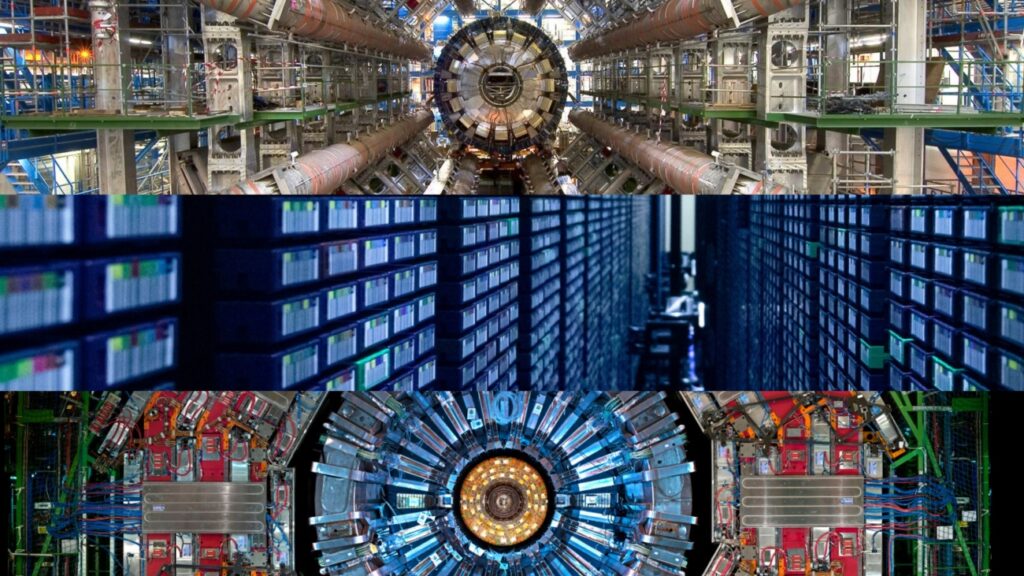
A five-year project, started in January 2024, to get more physics information out of HL-LHC data by selecting interesting events more efficiently. It is a collaboration between CERN’s Experimental Physics, Theoretical Physics and Information Technology departments and the ATLAS and CMS experiments. Connected to: Edge AI for Real-Time Data Acquisition.
The Inter-Experimental LHC Machine Learning Working Group (IML)
The Inter-experimental Machine Learning (IML) Working Group provides a forum for the machine learning community at the LHC. It brings together scientists from the LHC experiments, connects them to the data science community, fosters inter-experimental common solutions, and provides training and benchmarks.
FLARE
CERN and Mistral sign a statement of intent to advance AI for science and strengthen Europe’s scientific and technological capabilities.